
Product Roadmap Prioritization
Your backlog has 200 items. Your team can ship 10. ForceRank helps you pick the right 10.
The Roadmap Prioritization Problem
Product roadmaps often reflect the loudest stakeholder, not actual team consensus. The sales team pushes for enterprise features. The CEO has a pet project. Engineering wants to address tech debt. And the PM is left trying to balance everyone's wishes with limited capacity.
The typical approach — putting features in a spreadsheet and debating them in a meeting — fails because group discussions amplify the most vocal participants. Quieter team members with valuable perspectives stay silent, and the result is a roadmap that satisfies the loudest voice rather than the team's collective judgment.
ForceRank democratizes the input. Every person with a stake in the roadmap — PMs, engineers, designers, stakeholders — ranks the candidate features independently. The Schulze algorithm then calculates the mathematically optimal group ranking. The result is a roadmap backed by real data, not politics.
How ForceRank Prioritizes Your Roadmap
List Candidate Features
Add the features, improvements, and initiatives competing for your next release or quarter. Include 6-15 items for the best results.
Cross-Functional Ranking
Share the link with PMs, engineers, designers, and stakeholders. Everyone drags items into their priority order — independently and without bias.
Data-Backed Roadmap
See the consensus ranking and disagreement map. Use the results to build a roadmap that reflects real team priorities, not just the loudest voice.
See Your Team's Consensus
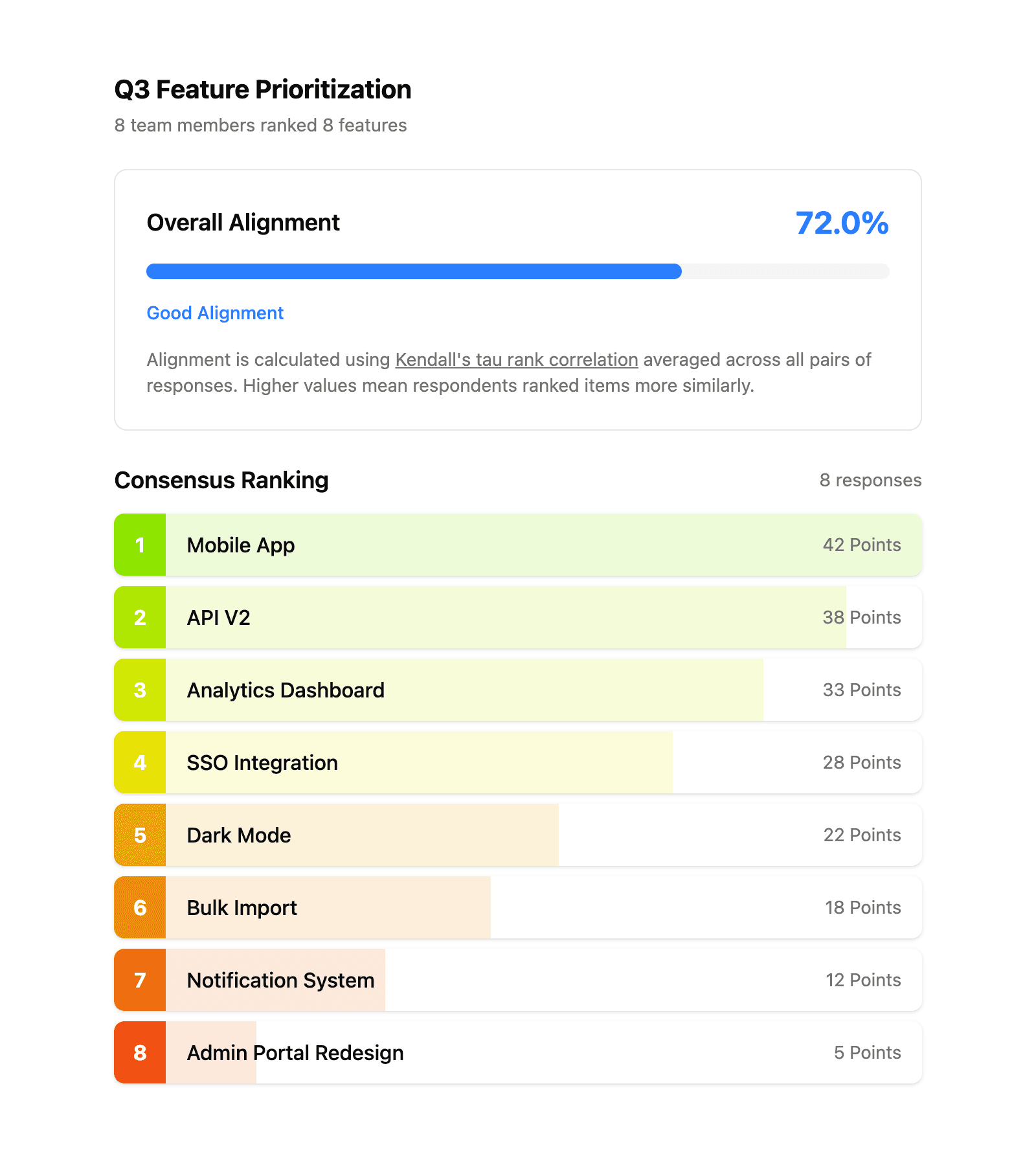
After your team ranks, ForceRank calculates the optimal group ranking and shows you exactly how aligned your team is.
See How Every Role Voted Differently
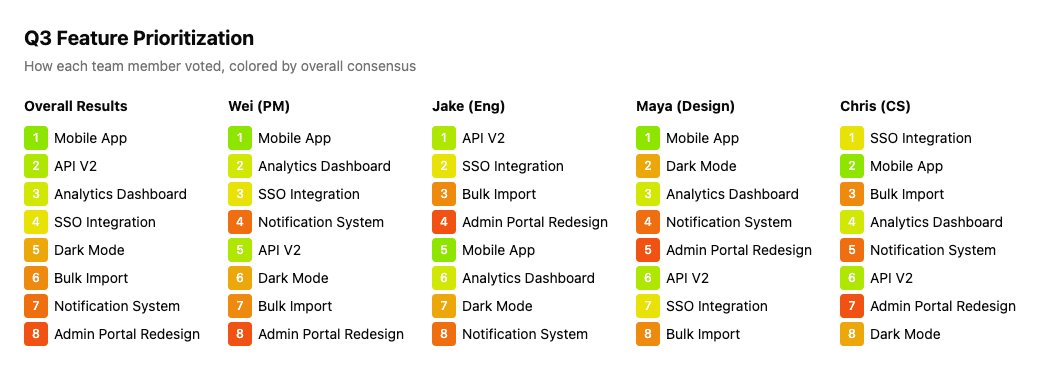
Your PM, engineer, designer, and customer success lead each see different priorities. ForceRank reveals these perspectives so nothing gets overlooked.
Try It: Prioritize Your Roadmap
Drag the items below to rank them in your order of priority.
Try it yourself — Q3 Feature Prioritization
Choices
Your Ranking
Product Roadmap Prioritization FAQ
- How do I prioritize a product roadmap?
- Start by listing your candidate features or initiatives — typically the top 8 to 15 items that are competing for engineering time. Share the ForceRank link with everyone who has input: PMs, engineers, designers, and key stakeholders. Each person ranks the items independently using drag-and-drop. ForceRank then uses the Schulze algorithm to calculate the optimal group ranking, showing you where the team aligns and where they disagree. Use the consensus ranking as your starting point, then discuss the contentious items to reach a final roadmap.
- Should engineers and PMs rank together?
- Yes — that is one of the biggest benefits. Engineers often have different priorities than PMs because they see different costs and risks. When both groups rank together, you surface those differences explicitly instead of discovering them mid-sprint. If you want to compare perspectives, create two separate rankings (one for engineering, one for product) and compare the results side by side.
- How many features should I include?
- Between 6 and 15 is the sweet spot. Fewer than 6 does not create enough tradeoffs to be useful. More than 15 fatigues participants — they stop thinking carefully about the bottom half of the list. If you have a huge backlog, do a rough triage first to narrow to 15 serious candidates, then use ForceRank for the final prioritization.
- Can stakeholders outside the team participate?
- Absolutely. ForceRank participants do not need accounts — just share the link. This makes it easy to include sales, customer success, executives, or even key customers in the prioritization process. Everyone ranks independently, so external stakeholders cannot dominate the conversation the way they might in a meeting.
Prioritize Your Roadmap
Create your first roadmap ranking in under a minute. Free for everyone, no credit card required.