
Stack Ranking Made Simple
Stack rank your team's priorities in minutes. Everyone ranks independently, then see consensus instantly. No more spreadsheets, no more hour-long debates.
What is Stack Ranking?
Stack ranking (also called force ranking) is a prioritization method where participants must order items from most to least important — no ties allowed. This forces real tradeoffs and prevents the common problem where everything is labeled “priority 1.”
ForceRank takes this method online, letting teams stack rank asynchronously. Create a question, share a link, and each team member drags and drops items into their priority order on their own time. The tool then calculates the mathematically optimal group ranking and shows you where the team agrees and disagrees.
Unlike surveys or dot voting, stack ranking captures the complete preference order from every participant. The result is a single, defensible ranked list backed by data from the entire team.
A note on terminology
Stack ranking for team prioritization is different from the controversial HR practice of ranking employees against each other (sometimes called “rank and yank”). ForceRank is for ranking priorities, ideas, and options — not people.
How Stack Ranking Works with ForceRank
Create Your Stack Ranking
Add the items your team needs to prioritize. OKRs, features, initiatives — anything. Share a link when you are ready.
Everyone Ranks Independently
Share a link. Each person drags items into their priority order. No ties, no groupthink. Everyone commits to real tradeoffs.
See Where You Agree and Disagree
The Schulze algorithm calculates the mathematically optimal group ranking and highlights disagreement. Now you know what to discuss.
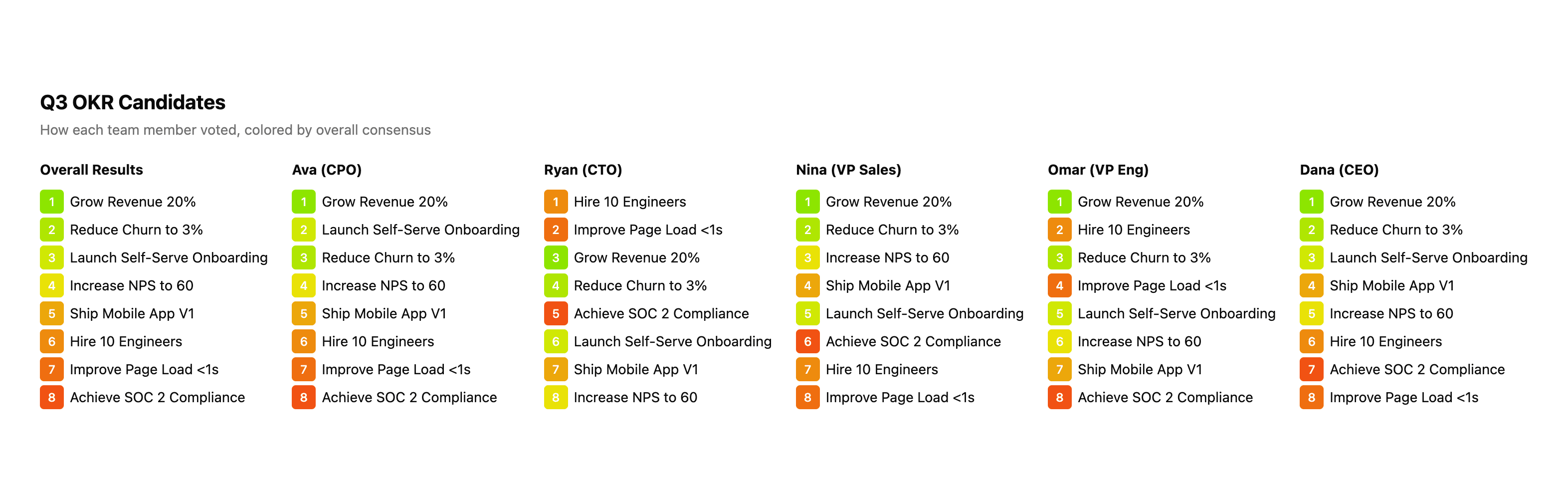
See How Everyone Stack Ranked
Each column shows one person's ranking, colored by the group consensus. Spot disagreement at a glance.
Built for Real Prioritization
No Ties Allowed
Forces real tradeoffs. No more "everything is high priority." Every participant must decide what actually matters most.
Async Participation
Team members rank on their own time from any device. No meeting required. Five minutes replaces an hour-long debate.
Consensus Visualization
See exactly where the team aligns and where they split. The results view shows agreement, outliers, and the items that spark the most debate.
Anonymous Mode
Let people rank honestly without social pressure. Enable anonymous mode so individual responses stay hidden — only the aggregate results are shown.
What Teams Stack Rank
See how teams use stack ranking for different types of decisions. Browse real examples to get inspired.
Annual Planning
Align leadership on which objectives matter most for the year ahead.
Product Roadmap
Let PMs, engineers, and stakeholders rank features independently, then find consensus.
OKR Prioritization
Stack rank competing OKRs to decide where to focus resources this quarter.
Budget Allocation
When everything is "high priority," stack ranking reveals what the team would actually fund first.
Teams that rank together, decide faster.
ForceRank replaces hours of circular debate with clear, data-backed priorities. Here's what teams say after making the switch.
“ForceRank was fantastic – we used it to prioritize our projects for the 2022 budget. It made the process transparent and got everyone aligned quickly.”

Matt Wojcik
VP of IT, US Radiology Specialists
“I love ForceRank. By virtue of its simplicity, it forces real prioritization decisions. No more "everything is priority 1" – you have to actually choose.”

Angela DeFranco
VP Product, SevenRooms
“ForceRank is an amazing tool. It helped us surface ideas and collaborate better as a team. The results view showed us exactly where we agreed and disagreed.”

Charles Tran
Founder, CreditDonkey
Stack Ranking FAQ
What is a stack ranking tool?
A stack ranking tool lets a group of people independently rank a list of items from most to least important. ForceRank aggregates all rankings using the Schulze method to find the optimal group consensus.
Is stack ranking the same as force ranking?
Yes. Stack ranking and force ranking are different names for the same method: ranking items with no ties allowed, forcing participants to make real tradeoffs.
Can I stack rank anonymously?
Yes. Enable anonymous mode when creating your question to let participants rank without revealing their identity.
How many items can I stack rank?
As many as you need. We recommend 5–15 items for the best experience — enough to surface meaningful differences without fatiguing participants.
Is ForceRank's stack ranking tool free?
Yes. Creating stack rankings is free, and participants never need to sign up.
What algorithm does ForceRank use?
ForceRank uses the Schulze method, a mathematically proven algorithm that finds the option that would beat every other option in a head-to-head matchup.
Ready to stack rank your priorities?
Create your first stack ranking for free. No credit card required. Share a link, get your team's input, and see where you actually stand.
Free for everyone. No limits. View pricing details.